
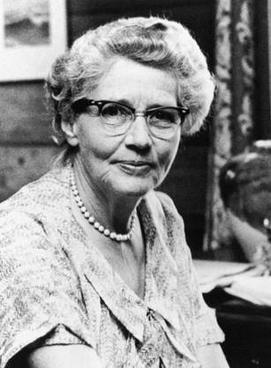
Helen Brooke Taussig (1898 – 1986)
In the mid-1940s, desperate parents of babies born with a heart defect known as Tetralogy of Fallot came from all over the world to Johns Hopkins Hospital (JHH) where Dr. Helen Brooke Taussig and her colleagues, surgeon Alfred Blalock and surgical technician Vivien Thomas, developed and used the Blalock-Thomas-Taussig shunt.
Tens of thousands of these “blue babies” went on to live normal lives.
This ground-breaking invention was only one of Dr. Taussig’s lasting contributions. She developed the specialty of pediatric cardiology and was the first female doctor to head the American Heart Association. Early on, Dr. Taussig recognized the threat of catastrophic birth defects from the drug Thalidomide taken during pregnancy and was a leader in the campaign to ban the drug. President Lyndon Johnson awarded her the Presidential Medal of Freedom in 1964 for her contributions to medicine.
Early Path to Excellence
Perhaps influenced by her mother’s death from tuberculosis when Taussig was 11, she attended Boston University to study the sciences. Her preferred choice, Harvard, did not accept women.
After impressing a professor with her study of ox heart muscles, he encouraged her to apply to Johns Hopkins University School of Medicine, which had been accepting women since 1893. (This is thanks to another Baltimore philanthropist, Mary Elizabeth Garrett, who donated about $500,000 toward JHU’s proposed medical school with the stipulation that women be admitted on the same terms as men.)
After attaining her Doctorate of Medicine in 1927, Dr. Taussig remained at JHH as a cardiology fellow and intern, focused on babies with congenital heart defects and rheumatic fever, a major killer of infants at the time. Many medical professionals regarded death from these diagnoses as almost inevitable.
Career
Taussig served as the chief of the pediatric department of Johns Hopkins, the Harriet Lane Home from 1930 until 1963. (The Harriet Lane Clinic was inspired and funded by another Baltimore philanthropist, Harriet Lane Johnston, after she lost her own son to rheumatic fever.)
In her lifetime, Dr. Taussig faced at least two big personal hurdles: She had dyslexia as well as a significant early-onset hearing loss. She read lips and used hearing aids through much of her career. Some said that her ability to understand the workings of the human heart came from her touch rather than the traditional mode of sound with a stethoscope.
Thousands of children’s lives were saved by the shunt procedure. (Originally, it was referred to as the Blalock-Taussig shunt: the important contributions of Vivien Thomas were overlooked at the time because he was not a medical doctor and because he was a Black man.)
The Blalock-Thomas-Taussig shunt is still used as a way to stabilize infants with congenital heart defects before subsequent and more complex surgeries are done to permanently repair the heart.
Retirement and death
Dr. Taussig died in an auto accident near Kennett Square, Pennsylvania in May, 1986, where she was living in a retirement community. At the time of her death, she was still traveling to the University of Delaware to take part in research. She is buried in Mt. Auburn Cemetery in Cambridge, Massachusetts.
Source:
Image: Public Domain from National Library of Medicine (via the Alan Mason Chesney Medical Archives)
Changing the Face of Medicine, Celebrating America’s Women Physicians, National Library of Medicine, accessed on September 19, 2025
https://en.wikipedia.org/wiki/Helen_B._Taussig accessed September 19, 2025
First Lady of Cardiology’ Dies in Crash: Dr. Helen Brooke Taussig Pioneered ‘Blue-Baby’ Operation: Los Angeles Times, May 23, 1986; accessed September 20, 2025.
Mt. Auburn Cemetery, accessed 9/22/2025