
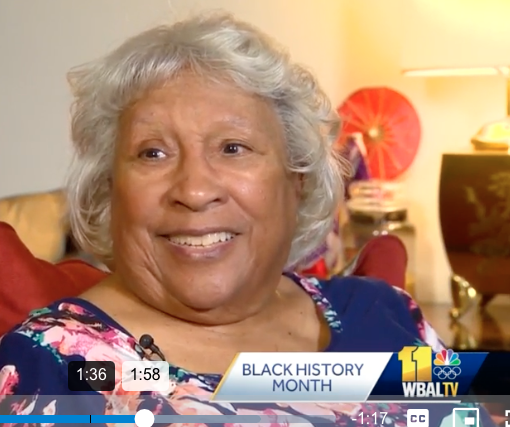
On a cold school day in 1955, Morgan State College student Helena Hicks didn’t plan to make history. She was simply standing at Baltimore’s Howard and Lexington Streets waiting for a bus. Several packed buses had already passed. Hicks suggested to six fellow students that they go into the nearby Read’s Drugstore to get something hot to drink.
They knew, of course, that Read’s lunch counter only served White people. It was part of an arbitrary system in, what was then, Baltimore’s biggest shopping district, For example, Black shoppers could purchase items in Reads but buy lunch. In neighboring department stores, Blacks could buy, but not try on, clothing.
Hicks was not new to civil disobedience: Her parents had been active in civil rights acts to desegregate several Baltimore institutions, including Fords Theater, the Hippodrome and Hutzlers Department store.
She said, years later, that it was somewhat of a spur of the moment action.
Read’s Employees were shocked and, some, belligerent, she recalls. Police were called; they were somewhat bewildered. The group eventually left since Hicks, a college senior, was reluctant to find herself arrested so close to graduation.
Morgan State University faculty were supportive: “We were doing what education teaches you to do” said Dr. Hicks years later. “Make the world a better place to live in.” Not long after, Read’s agreed to desegregate its Baltimore stores.
Hicks went on to earn a M.S.W in Public Welfare and Psychiatric Counseling from Howard University in 1960, and later, a PhD in Public Policy from the University of Maryland. In an interview for her mother’ obituary her daughter Lynne Wilson recalled that she operated a day care business, took care of her two children and attended college at night.
This spur-of-the-moment act of defiance at Read’s was not a one-off, though. In years that followed, Helena Hicks became one of Baltimore’s most iconic civil rights advocates. Her career started as a case worker for the city’s social service agency and moved through higher level positions in the city’s housing authority and department of human services. Along the way, Hicks rose to the occasion when civil rights and historical issues arose in her neighborhood. She served as a long-time president of the Park Grove Neighborhood Association, working to solve issues like local pollution and saving historically important local buildings from demolition. Most notably, she stood up to vociferously protest the intended total demolition of the former Read’s drug store where Hicks and her friends changed history in Baltimore. Issue by issue, she worked to bring justice to her neighbors. In doing so, this 4′ 11″ woman became a towering figure in Baltimore history.
Sources:
Building that held first civil rights sit-in for sale in Baltimore, WBAL TV, David Collins, Feb 28, 2020 , accessed 11/5/25
Helena Hicks: A participant in the Read’s Drug Store sit-in talks about changing history on the spur of the moment By Andrea Appleton, City Paper, Published February 22, 2012, accessed 11/5/25