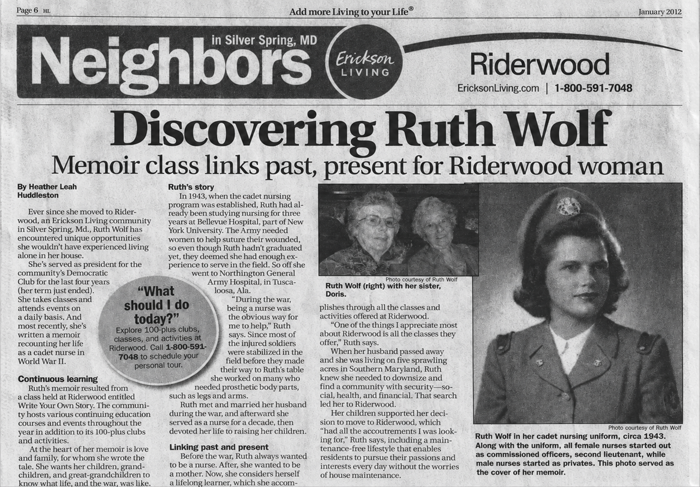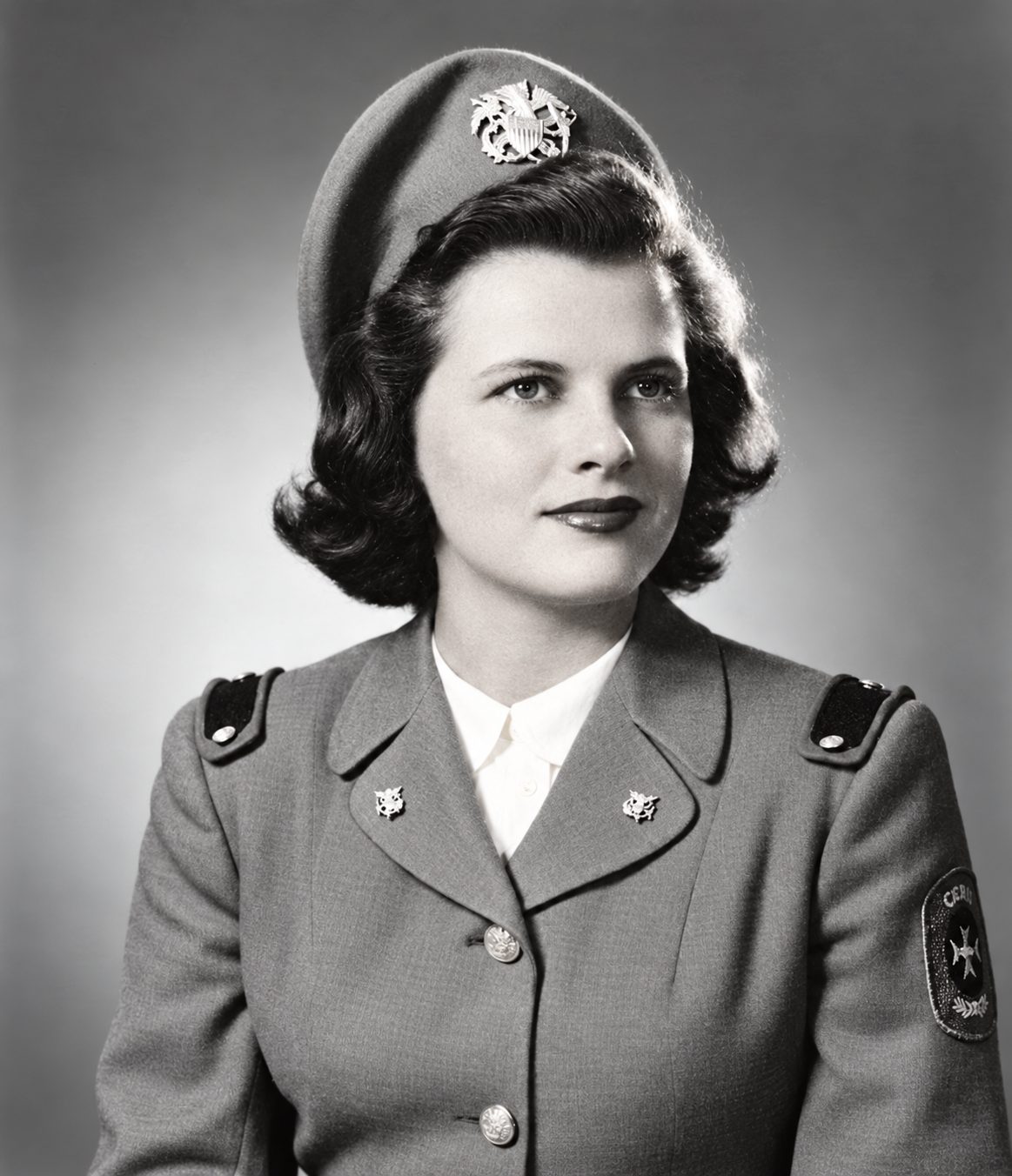
Ruth S. Wolf’s 2020 obituary summarized her extraordinary volunteer work in both Prince George and Calvert counties. She worked with Prince Georges County League of Women Voters and Governor’s Council of Education and other agencies, and the Prince George County Board of Education. When she and her husband retired to Calvert County, a co-founder of Calvert Hospice and Adult Day Care and remained active in many other local committees and commissions.
However, a passage from her memoir, Ruth’s Stories, about her experiences as an Army cadet nurse and written after she took a writing class at Riderwood Senior Living Community, perhaps best summed up her character. She vehemently stood up for the better treatment of psychiatric patients:
“Bellevue
My mother was never enamored of my early decision to become a nurse. She was more than a little upset when I announced that my choice of schools was New York University, and its infamous hospital BELLEVUE. Bellevue Hospital was then the second largest hospital in the country (the largest was Cook County, Chicago). We agreed to let the family doctor mediate the decision. Much to my mother’s amazement he endorsed my choice, telling my mother,
“If Ruth really wants to be a nurse that is the best choice she could make.” That ended that debate.
Bellevue Hospital was an institution much like a very ancient version of Riderwood. There were many buildings, each building housing a different medical specialty; one was for surgery patients, another for medical patients, a third for pediatrics, and then, a whole separate building for tuberculosis, and another for Bellevue’s infamous Psychiatry. Each floor in each building was supervised by a different University’s medical school. These included Cornell, McGill in Canada, Columbia and Harvard.
The many buildings were connected by passageways; but these passage ways were not the bright, heated, air-conditioned halls of Riderwood, but dark basement tunnels with pipes and wires strung through them. We were sure they contained all kinds of creepy, crawly things. More than once I encountered a rat.
Off to Bellevue I went. As students, the first six months were spent only in classrooms, but after that we spent three to six months in each building- learning the many facts and practices that would, eventually make us eligible to become graduate nurses. Since Bellevue covered almost all medical specialties we had to matriculate at only one other hospital. That was Willard Parker, a Bellevue subsidiary, located further south along the East River, behind a gas tank storage garage. This hospital was for communicable diseases.
I was working there one night, taking care of a good-looking fourteen year old with polio, in an iron lung, when the power went off. No moral dilemma there. I simply pumped that iron lung all night until the power was restored. I was feeling very satisfied with myself as I went off duty that my patient was still alive. I was totally devastated the next evening when I came on duty to find he had died during the day. Fortunately such contraptions are no longer necessary.
Many students from other hospitals did come to Bellevue if their particular hospital did not proffer a particular service. This was especially true of psychiatry. Since both the moral dilemmas of which I write occurred in a psychiatric setting it probably says much about my own ambiguous attitude to that venue.
After three months on the ward treating patients with schizophrenia (now called bi-polar disorder) I was transferred to the male violent ward. Before the war only male nurses and attendants had been permitted to work on this particular ward. A few other female nurses from other schools were transferred there with me. Each was from a different school, and we did not know one another before we were assigned. The supervisory personnel did really not know what to do with us. We were each assigned a single patient, and told to try to develop a connection. Since they were mostly cationic this was difficult and very frustrating. We tried.
During a break we had noticed about six cots in a back room. The patients therein were wearing straight jackets and were tied down in their cots. They, obviously, had not had daily or perhaps even weekly care. They were filthy, soaked in excrement and smelled vile. As a group we decided something had to be done. Against orders we, together, untied each patient, separately, washed them, changed their bedding, gave back rubs and made them as comfortable as possible before retying the restraints, and going on to the next patient. As we finished the last patient we were “caught”. I, the one student from Bellevue, I was deemed the ring leader, which I probably had been. The head nurse, a long time officious burly male recommended me for expulsion. I was sent to see the Dean
I went, shaking in my unglamorous shoes, but unrepentant, and unapologetic. Fortunately my only prior contact with the Dean had been of a complimentary nature. I explained the circumstances; how wrong I thought it was to leave some patients totally unattended while we tried therapy of very questionable value on others. The Dean was a very kind and understanding person. She recognized my dilemma, and agreed with my decision. Moreover a rule was promulgated that every patient, on every ward would receive daily care before therapeutic interventions would be started. I felt vindicated, but was not reassigned to the male violent ward.
A year or so later, still a student, I was assigned to an army hospital, and again to a psychiatric ward. As an interesting aside, both the army and the hospital were then segregated, but the psychiatric ward was not. A common diagnosis was then called “battle fatigue”. During WWI it had been called “shell shock”, and I believe the diagnosis now is “post traumatic stress syndrome – PTSD.” A frequently prescribed treatment was shock therapy. Sometimes this was administered with insulin injections, in which case it could readily be reversed with orange juice or a sugar injection. Often the shock was administered by electric shock a la One Flew Over The Cuckoo’s Nest. I found the results devastating. As a person who cared for the patients for hours and days after the shock had been given I saw, what I perceived to be, deterioration in their conditions. I express my dismay, of course, I was ignored. The treatment continued, I continued to object, more vociferously; then to higher authorities. I was then “invited” into the commanding officer’s office:
“What is your objection to electric shock therapy?”
I tried to explain my observations of deterioration.
“If you can not obey orders you don’t belong in the army.”, but since I wasn’t exactly IN, but merely assigned to, the army he couldn’t kick me out. I was a cadet nurse, with no standing whatsoever in the hierarchy. This was a physician and a Major General. Nothing changed. As punishment I was transferred to the Operating Room where I, happy to be away from psychiatry, spent the rest of my time assigned to the army.”