
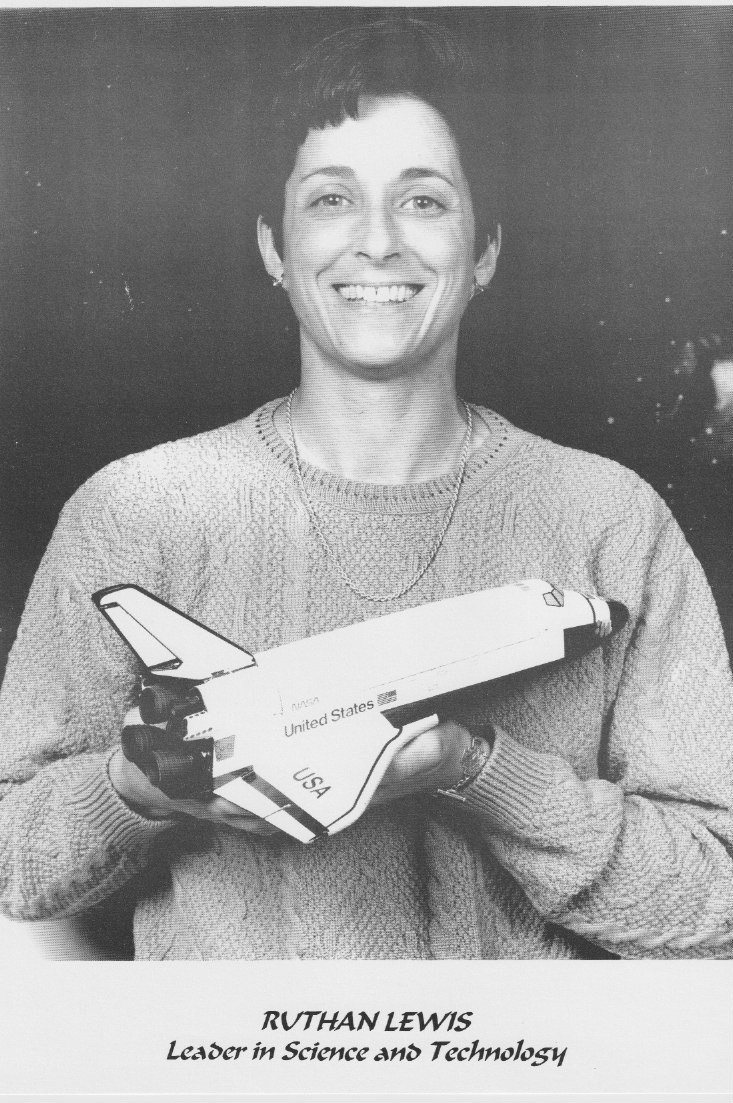
Note: Ruthan Lewis was featured in the 1997 Women Leading the Way educational resource kit. At that time, her biography read as follows:
“It is important to accept challenges. Taking risks may not be comfortable, but as a leader if you stretch your comfort zone you may end up stretching yourself, your mind, your abilities.”
Ruthan Lewis, Ph.D., is a Mission Manager and Project Engineer for a variety of Space Shuttle payload programs at the NASA Goddard Space Flight Center. She has helped to develop astronaut tools, design spacecraft, and train astronauts. She hopes to someday personally travel in space.
________________________________________________________________
As of 2026, Chat GPT summarized her career and shows that Dr. Lewis’s career contributed to a wide range of pioneering space expeditions, including Artemis, during which Christina Hammock Koch became the first woman to fly around the moon. Dr. Lewis’s contributions focused on planning how astronauts would operate and live on the lunar surface:
Ruthann Lewis has had a long NASA career centered on human spaceflight, spacecraft habitation, ergonomics, and the design of systems that allow astronauts to live and work safely in space. NASA records describe her as having worked at three NASA centers, with responsibilities spanning the Space Shuttle, International Space Station, Hubble Space Telescope, and later exploration systems for the Moon and Mars. NASA Technical Reports Server
Among the positions NASA credits her with are Space Shuttle Mission Manager, International Space Station Research Manager, and Hubble Space Telescope EVA Systems Manager. Her Hubble work is particularly interesting because EVA—extravehicular activity—covers the systems and procedures astronauts use while working outside a spacecraft, an essential part of Hubble servicing missions. She also worked in human ergonomics and human interaction with the space environment, as well as coordinating science and engineering and developing spacecraft habitation concepts. NASA Technical Reports Server
Later in her career, Lewis became Exploration Systems and Habitation Manager at NASA’s Goddard Space Flight Center. In that role, NASA says she led the formulation, development and design of systems for human exploration of the Moon, Mars and deep space. That represents a progression from supporting individual Shuttle, ISS and Hubble missions to helping determine how future astronauts could actually live and work during long-duration exploration missions. NASA Technical Reports Server
Her educational background is unusually interdisciplinary and helps explain that career. NASA lists a Ph.D. in Industrial and Biomechanical Engineering from Texas A&M University, an M.S. in Industrial and Biomechanical Engineering from Texas Tech University, an M.S. in Architecture from Catholic University, and bachelor’s degrees in Architecture and Biomechanics from the University of Maryland. NASA Technical Reports Server
That combination of architecture + biomechanics + engineering is especially relevant to spacecraft habitation: designing a spacecraft isn’t simply an engineering problem; designers also have to consider how people move, sleep, work, operate equipment and remain healthy inside a very restricted environment.