
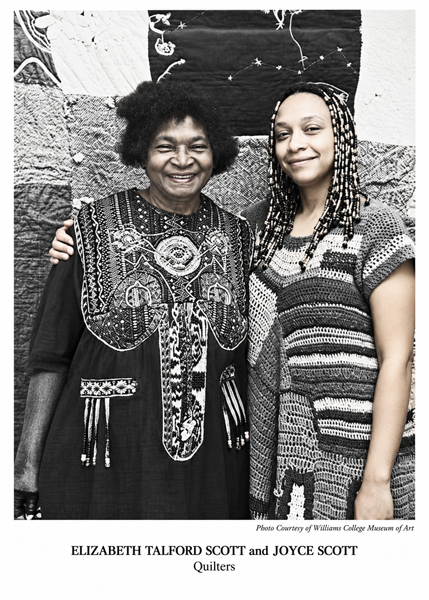
Elizabeth Talford Scott and her daughter, Joyce Scott, are nationally known quilters whose works are rooted in the African-American tradition of quilt making. The family tradition began with Elizabeth’s mother and father, both of whom were quilters. Elizabeth was born in 1916 and settled in Baltimore in 1939 and Joyce was born in Baltimore in 1947. Their work has been exhibited at the Smithsonian Folk Life Festival and in many art galleries.
Elizabeth’s family were sharecroppers, living and working the same land where her grandparents had been slaves. The type of utility quilt that her mother taught her to make was not only for family use, but also for trade as payment for goods and services. Years later, when Mother Scott was a domestic worker in Washington, D.C. she continued making the traditional block quilts, either from left-over fabric, or from material provided by her clients. Mother Scott’s bold designs are highly original, yet are also firmly rooted in the Afro-American tradition of quiltmaking.
Joyce Scott has considered herself an artist since the age of twelve. Although she trained professionally at the Maryland Institute, The Instituto Allende in Mexico, The Haystack Mountain School of Crafts in Maine, and The Rochester Institute of Technology, her first teacher, by her own acknowledgement, was her mother: “This to me is an initiation rite, or puberty rite… My mother’s giving me knowledge of quilting.”
Joyce Scott has commented that, “Quilters tell stories with their work and then they wear or display it. So what I’m doing is chronicling my family.” The traditions and stories of herself, her mother and grandparents is chronicled in her Three Generation quilt: all the family members, living and dead, are bound together by a yellow stitched thread (yellow is the color of bright sunlight) which radiates out from a central heart motif. The heart of the family.
Scott shares her multi-ethnic experiences and artistic skills with students of all ages. She spends time teaching in the public schools, working with senior citizens, and in art schools and various workshops around the country.
Sources and read more:
350 Years of Art and Architecture in Maryland, The Art Gallery, University of Maryland, College Park, 1984
Maryland Women at Work, Maryland Women’s History Project, 1990s, Maryland State Department of Education