
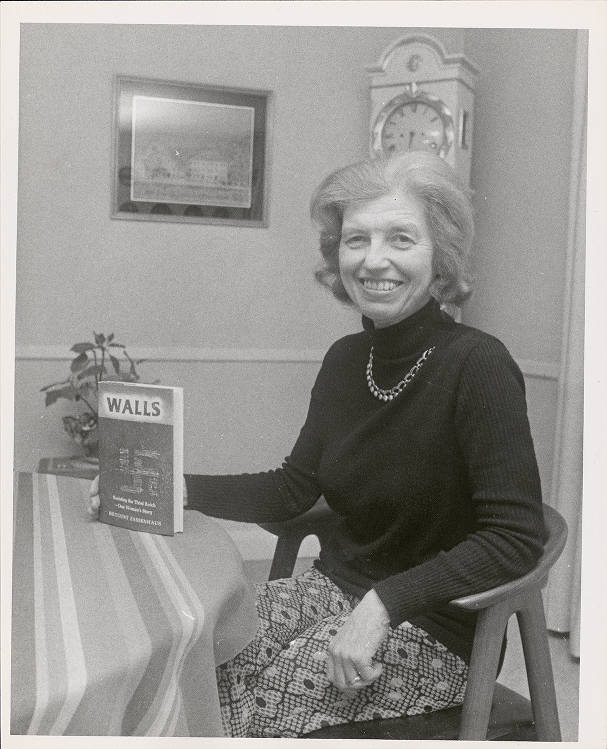
Dr. Hiltgunt Margaret Zassenhaus (1916 – 2004) is best known for her work against the Nazis during World War II. She was born to a Christian family in Hamburg, Germany in 1916. Her first act of defiance was as a schoolgirl when she refused to salute Hitler as ordered. One day, out of desperation, she broke a classroom window rather than obey the order to salute.
During the years that followed, she earned a degree in Scandinavian languages while taking medical classes at the same time. After completing her studies, she was hired by the Department of Justice to censor mail written by Jews in Polish ghettos to friends and relatives in Scandinavia. She used this opportunity to pursue her work against the Nazis. Instead of deleting passages, she wrote notes of support in the margins and obtained help for many.
Later when she was given a more responsible position, that of supervisor of Scandinavian political prisoners, she saw this as an opportunity to do even more although it meant putting herself at greater risk. Because she worked for the Department of Justice and ranked above the guards and officials in the camps, they were fearful of her. Thus, she was able to carry out her work with relative ease. Through her efforts and connections with the underground, she was able to save 1,200 prisoners from execution.
In 1952, she accepted an offer to work at the University of Maryland Medical School in Baltimore. She has been in private practice since 1954, specializing in internal medicine and has hospital privileges of Greater Baltimore Medical Center and Maryland General Hospital.
For her courageous work, Dr. Zassenhaus was knighted by the King of Norway and by the King of Denmark. She has written two books about her wartime experience: Halt Witch in Dunkel (On Guard in the Dark) in 1948 and Walls in 1974. She received a Nobel Peace Prize nomination for Walls, her autobiography. Perhaps the most important message from Margret Zassenhaus is that we must challenge apathy and complacency. This was true in the 1930s and 1940s, and it is just as true today.
She tells us that: “…even in the most desperate circumstances we as individuals can make choices. This is what being human is about. We must never cease to listen to our conscience. If it guides us towards serving life, then we are on the right course.”
Resources and More Reading:
Maryland Women’s History: A Patchwork of Many Lives, produced by Maryland State Department of Education and Maryland Commission for Women
Dr. Hiltgunt Margret Zassenhaus Collection – Enoch Pratt Free Library